Hi there everyone. I am doing fine and hope you all are doing the same. Today’s topic is a lot different from my previous ones because it is filled with a lot of sadness and grief. In this session I will be talking about an incident that not only shock the world with its news but also dashed the dreams of some of the finest footballers together with their lives. If you guessed it correct, then yes I will be highlighting the story of the Munich Air Tragedy, which took place 63 years ago.
The Busby Babes
6th February 1958, went down into the history books both in the word of football and in the field of aviation after British European Airways flight 609 crashed on its third attempt to take off from a slush-covered runway at Munich-Riem Airport, West Germany.
The crash that took 23 lives included 8 Manchester United plays labelled as the Busby Babes as a result of their sporting success had no idea that this journey back home would turn into a nightmare.
A day after the Busby Babes made it through to the European Cup Semi-final the club squad, staff journalists and other passengers boarded the British European Airways flight to Manchester.
BEA flight 609 before take-off to Manchester
The aircraft was refueled and failed to take off twice due to engine problems. Since it began to snow heavily and was likely the journey would be delayed till the next day, the crew were eager to be on schedule forcing a third attempt.
BEA flight 609 crashes
However, by now the snow had caused the runaway to be carpeted in thick blanket of slush, which did not allow the plane to gain its maximum speed to take-off causing it to skid at the end of the runaway, crashing through a fence surrounding the airport and went into a nearby house.
Thick flames caught the plane as the house engraved in fire, before a hut filled with tires and fuel exploded.
Twenty passengers died immediately, with three dying in hospital three days later followed by another in hospital fifteen days after the incident.
Legal actions against pilot, James Thain and airport authorities were taken, bur were cleared a decade later when findings revealed that the crash occurred as a result of the slush on the runaway causing the aircraft to slow down.
Before I end this write up, I would like to provide an insight about a clock installed at Old Trafford, the home of Manchester United Football Club which has been placed as a memorial symbol for the Munich incident. It has the full date and time at which the plane crashed.
Hello everyone! It’s time for the release of another blog and in this session I will be talking about one of the most fascinating creature’s on the planet, known as the Wandering Albatross. I will be sharing some interesting facts about this animal. So be sure to read it till the end.
The Wandering Albatross
Residing in the Southern Ocean including the Antarctic, sub-Antarctic and subtropical waters, this seabirds have a life expectancy rate of up to 50 years, a rare gift from god.
Commonly called Albatrosses belong to the Diomedeidae family with the same scientific name and labelled as Flock according to their grouping.
This bird can fly 16 miles per hour but if there’s more and strong wind it will work in the species favor as it will give them more push in the air, increasing their flying speed.
Learn more here
What caught my attention and motivated me to write about this bird is its ability to fly non-stop without flapping its wings.
Once in full flight, the Albatross returns to land after 5-7 or in some cases more years. I find this piece of information interesting because normally birds fly and return to land and flap their wings while flying but this creature are incredible in nature.
Its wingspan are 6.5- 11 feet.
The albatross have an average weight of up to 22 pounds.
Learn more here
If we talk about their diet, then Albatross are carnivores meaning animals that eat other animals for survival. Some of the animals these birds feed on are fish, cephalopods, jellyfish and crustaceans.
Now, if you are wondering why this creatures come to land after a massive lapse of years?
Well, the answer is breeding. Just like humans and other living organisms, this species also desire to have children and uplift their dynasty.
Once on land, they form large colonies on remote islands. The mating pairs lay a single egg and take turns carrying for it.
A young Albatross may fly within 3-10 months, depending on the bird but once it leaves land behind, they are on a journey until they reach a sexually matured age.
Interestingly, some of them stay on land and mate for life. (Wow! Party on all day every day. Just joking).
Presentation summary
That’s it for now. Hope you enjoyed reading it. Many thanks. Bye for now.
Hi there everyone! Wishing you a Happy & fruitful 2021. I know 2020 was the worst year ever but this is a new set of 365 days so let’s hope for the best and try to make it the best.
So for the first blog of 2021, I thought to share some light on a few endangered animals in the world. I feel we do not talk about them probably because we don’t have any idea they exist. Honestly speaking, even I have heard about these animals for the first time and if we want our future generations to know about all these endangered living organisms then, it is critical that they are preserved.
Save Animals
Now, the first animal that I wish to draw your attention to is Amur Leopards. Located in the Far East of Russia, these species are the rarest big cats in the world.
One of the unique feature of this animal is its ability to run at a speed of 37 miles per hour. It can also leap up to 19 feet horizontally and 10 feet vertically.
Amar leopards have spots like fingerprints enabling one to identify them individually.
Its hair in summer are 2.5cm long but are replaced by 7cm long ones in winter, enabling it survive in both climates.
This is a night cat which is why photographers use infrared cameras to take pictures.
This species are highly protected in Russia, anyone found hunting the animal is likely to face fine up to 1,100,000 Rubles and jailed for 2 years. Storing, transporting or selling their parts carries a fine of up to 1 million Rubles and 2 year imprisonment. If a group is guilty of such crime, it can be fined close to 2,000,000 Rubles with a jail term of approximately 5-7 years Info source: https://www.wwf.org.uk/learn/fascinating-facts/amur-leopards
The Amur Lepard
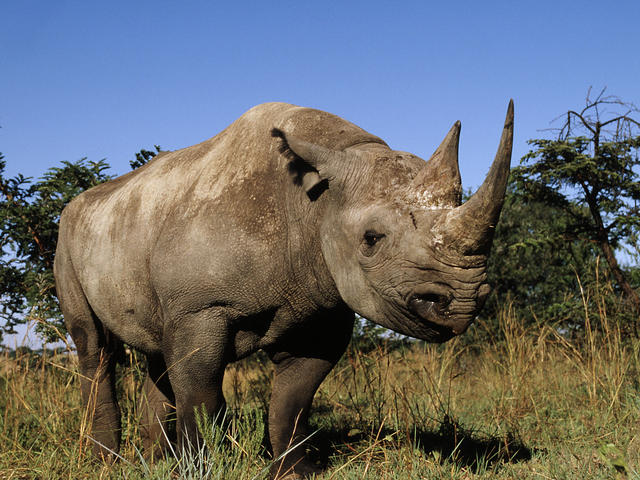
At number 2 is the Black Rhino. These species roamed many places throughout Europe, Asia and Africa and were well-known to the early Europeans, who depicted it in their cave paintings.
Today, around 27,000 rhinos remain in the wild compared to 500,000 at the beginning of the 20th century. The decline is due to massive hunting and loss of habitat over decades, as a result very few survive outside national parks and reserved areas.
Three species of rhino including black, Java and Sumatran have been classified as critically endangered.
The feature that makes this creature unique is its pointed upper lips which allows them to pluck leaves and fruits from the branches.
The black rhino has a maximum speed of 55 km per hour with life expectancy rate between 35-50 years. It also has a gestation period of 15-16 months.
Bornean orangutan is in at number 3. The animal population has declined by more than 50% in the past 60 years, with its habitat been depleting by at least 55% over the last 20 years.
The Bornean orangutan differs in appearance from Sumatran orangutan, with a broader face and shorter beard with a slightly darker skin color.
The Northwest Bornean orangutan are the most threatened subspecies compared to the Northeast and central ones, as its habitat has been greatly affected by logging, leaving barely 1,500 individuals aside.
This species weigh between 66 -220 pounds and are 3.3 to 4.6 feet in height.
To conclude, it is pretty evident that over harvesting of such species and destruction of its natural habitats have been the cause of its verge of extinction.
Thanks for reading. Hope you enjoyed this short presentation.
Hi everyone! It’s good to be back. Today’s topic is a lot different from the usual politics or sports. If you are a fan of horror movies or stories like me then you might find it fun and interesting to read today’s presentation because today I will be talking on one the worlds most popular horror game called Ouija Board.
Now, some of you maybe familiar with this game or the Ouija board while others might not. Some may have even experienced playing with it but to be honest I have not tried out and given its dark side I never wish to try it out at any point of my life.
With that being said, the reason I call it a creepy game is because it is used to contact with sprits. For a fact, I love horror movies, series, stories and learning about supernatural stuff. But I understand there is a fine line between natural and supernatural things.
It may seem fun playing with it as the tool provides an opportunity to connect with the other world but at the same time it can prove to be dangerous. It’s like entering in someone’s space without permission or even allowing a spirit into your world can be more risky and fearful.
Another interesting point about the Ouija board is that, it was frequently used during and after several wars around the world particularly following the world wars as many families tried contacting their deceased loved ones.
As far as the game’s origin and description is concerned, it all began in 1890, when Helen Peters, a woman known by her family as a spiritual medium who was a devotee of the arts. She sat in the boardinghouse room of her brother-in-law, Elijah Bond, using a board and planchette https://www.google.com/).
Well ironically, Baltimore, Maryland is located in the United States but the name and description of Ouija refers to the “Egyptian Luck Board” (https://www.google.com/).
Baltimore, Marylsnd USA
Just like rules are a feature in every game we play, the Ouija game is no different. The only fear factor is that if any of the rules are broken, it may prove to be costly for participant(s) and their loved ones. So, here are some laws that need to be followed during the cause of the game.
Never use an Ouija board alone: there is a risk for a spirit to easily manipulate or possess you.
Never use Ouija board in a cemetery: you never know what kind of spirit you might bring with you.
Never burn an Ouija board: simply you will not be able to get rid of it. The board will turn up at your home, either as gift from someone or in other supernatural way.
Do not leave a planchette alone on Ouija board: it’s believed to be bad luck.
Do not ask when you will die: I suppose it’s not a good idea as the reply might freak you out or you might get worried over it and has greater chance of influencing future decisions.
Always say GOOD BYE! Take the planchette to the goodbye at the bottom of the board and tell the spirits you are closing the board and none of them are permitted to follow you. This way you are protecting yourself, in case a bad spirit might try coming with you.
Lastly, materials required and method of play: for those who wish to try the Ouija board ensure to have at least two participants, so you don’t break rule number one, you need an Ouija board- a board- a board on which YES is written on the left side with NO on the right side of the board alongside numbers 1-0 and alphabets A-Z with GOODBYE at the Bottom of the board. You need a planchette (a triangular object) which will move in response to the questions being asked. A white candle is necessary to be lit prior to the start of the game, as a sign of respect to the spirits.
Finally, I hope you liked the presentation. It may be fun trying out but dangerous at the same time. So if you are thinking of trying out be very careful and my best wishes are with you. However, I personally feel such things are against the law of nature especially anything to do with finding the future is certainly we all are keen on knowing about but it can weigh heavily on s later on. So it’s best to keep going with the flow and we will find out eventually what future lies ahead of us.
Hi there everyone! It’s good to be back on blog mode. Today’s presentation is slightly different as I will sharing with you a presentation I did recently, which was also part of ome of my courses.
This week’s presentation focuses on failed states with respect to two Pacific island nations. The presentation write-up will unfold in two parts. Firstly, it will provide three definitions of a failed state, then with reference to Papua New Guinea, (PNG). It will discuss reasons for Australia’s intervention in PNG crisis and the Enhanced Corporation Program which aimed to improve the socio-economic and political situation in PNG. The presentation will then conclude by discussing the reasons for the establishment of the Regional Assistance Mission Solomon Islands (RAMSI), how it was formed and major achievements between 2003- 2013.
To begin with, a failed state or nation is one who’s political and economic system is so weak that the government has no control over it (google, n.d.). According to Robert I Rotberg, failed states are tense, deeply conflicted, dangerous and bitterly contested by warring factors (Rotberg, 2002) The enduring character of violence against the government or regime demands shared power autonomy that justifies violence which can be defined as a failed state (Rotberg, 2002).
Flag of Papua New Guinea
Before going into details of the Enhanced Corporation Program (ECP) it is important to understand the reasons for Australia’s intervention in Papua New Guinea. PNG were facing severe development challenges in areas of law & order, justice, corruption, poor financial management and governance (Australia, n.d.). The failure of any Prime Minister to serve a full five year term in the Papua New Guinean Government (Australia, n.d.), is an example of a politically unstable nation. Likewise, weak domestic demand & 2% economic growth in 2003 (Australia, n.d.), could be said to have created an unstable economy, alongside trouble in managing borders to ensure transport safety & security (Australia, n.d.), could be classified as a social instability, as this could easily open up scope for terrorism or terrorist groups to enter and setup a base in such countries.
The Enhanced Corperation Program
The Enhanced Corporation Program was signed in December 2003, to address the economic and development challenges in Papua New Guinea (Australia, n.d.). There were about twelve provisions of the ECP agreement. Some of the features of the agreement includes; “Provisions to enable the deployment of Australian police & other personnel to work with PNG government in areas of law & order, justice, governance, financial management and socio-economic progress, decreeing Australian personnel and their families observe PNG laws and regulations, compliance with international laws and Establishing a system to deal with claims against Australian personnel” (Australia, n.d.).
Flag of the Solomon Islands
The Regional Assistance Mission Solomon Island (RAMSI) played a significant role in stabilizing socio-economic and political situation in the Solomon Islands. RAMSI was formed in 2003, when Sir Alan Kemakeza, the then Prime Minister of Solomon Islands called for an urgent request for international assistance (About RAMSI, n.d.). The request was then heard and agreed by the Pacific Islands Forum to form a regional assistance mission funded and led by Australia and New Zealand with the support of other Pacific Island Forum member countries. So, in June 2003, Prime Minister Allan travelled to Australia to formally receive offer of assistance (About RAMSI, n.d.).
RAMSI LOGO
The reason for RAMSI’s establishment was “to address civil unrest, lawlessness, economic decline corruption and significant drop in service delivery and government administrative standards” (About RAMSI, n.d.). This became the basis of the RAMSI Treaty signed on 24th July 2003, to allow the deployment of police and military offices to Solomon Islands” (About RAMSI, n.d.).
As far as success of RAMSI is concerned, the mission has been successful in restoring law and order, rebuilt national institutions and reformed the economy of the Solomon Islands (About RAMSI, n.d.).
To conclude, a failed state is one where the government has no control over its socio-economic and political situation. Both Papua New Guinea and the Solomon Islands faced major social, economic and political instability through failure to maintain law and order, unable to contain corruption, as well as solve finical management and governance issues. The Enhanced Cooperation Program (ECP) in Papua New Guinea and the Regional Assistance Mission Solomon Islands (RAMSI) played an instrumental role in providing a stabled social, economic and political society as it managed to restore law and order, rebuild international institutions and reform the economic system of the Solomon Islands.
Thank you for reading. You can refer to the list of biblographies given below.
Dear readers. This is a special blog edition to mark the 5oth year of Fiji’s Independence. The article contains a very brief history of Fiji’s independence and how the state has grown overtime to what it is today. The write-up hopes to empower the young population and wishes for a brighter Fiji ahead.
Levuka, the Old Capital of Fiji. Also where the Deed of Cession took place.
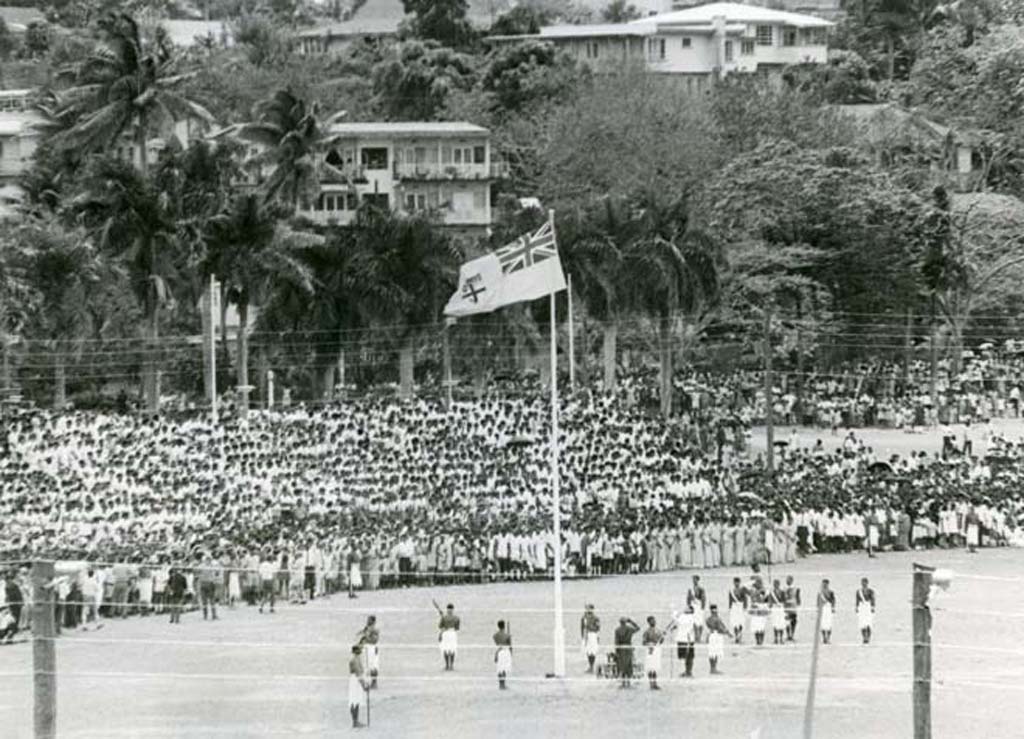
Fiji was ceded to Great Britain in 1874 by Ratu Seru Cakabau and gained independence on 10th October, 1970 at 10am at Albert Park in Suva, Fiji by Prince Charles.
Image of 10th October, 1970 at Albert Park Suva, Fiji
Over the past 50 years, Fiji as a nation has experienced many ups and downs which includes four coups between 1987 and 2006 causing socio-economic and political instability, faced the impacts of Tropical cyclone Kina between December 1992 and January 1993 and Severe Tropical Cyclone Winston in 2016 and could be said to have greater ethnic tensions between the indigenous population and Indo-Fijians in particular.
The Flaying Fiji Flag
However, today Fiji is defined as a multicultural and democratic nation with every citizen given a common identity as “Fijians” and their rights being protected under the 2013 constitution. While the state has progressed politically, socially and economically, its infrastructure and technological advancement cannot be overlooked. People of Fiji now have access better roads, high speed internet connectivity, and access to clean water and electricity in most of rural and maritime islands.
Fiji’s Commemorative 50 Coin & Bank Note
As we mark our 50th year of independence, we must take out time to reflect on the things we have learnt throughout the years and work towards a better future for our country. I urge you all, the young and future leaders of tomorrow to contribute in the best way possible to the development of our beloved nation. I encourage you all to stand united as it reflects the level of diversity that Fiji persist. With those words. Thank you for reading and May God Bless Fiji.
Hi there everyone! Hope you all are in good health. Today I’ve decided to shift my focus back to sports and will take a look at the UEFA Champions League quarter-finals 2nd leg which set to resume on the 7th of August.
For those that don’t know much about this competition, just to let you know that it is one of the biggest European club completion where some of Europe’s top clubs battle it out on the football pitch to become Europe’s BEST football club and earn a chance to represent the Europe at the FIFA CLUB WORLD CUP held annually.
UEFA CHAMPIONS LEAGUE TROPHY
I know the trophy looks big & beautiful right? To be honest it’s more than just representing Europe at the Club World Cup or calling yourself “CHAMPIONS OF Europe”! It’s also about the trophy you’re seeing above and the pride and prestige that comes with it. Plus so much money involved to be earned. That’s why clubs don’t take this competition lightly at all.
But I think what makes this competition & the sport more beautiful is the “UEFA CHAMPIONS LEAGUE ANTHEM”. Just imagine standing in front of thousands of football fans in a stadium and that music is played at the highest volume possible. Just think what it feels like at that moment? And what would be going through each player’s mind while the anthem is going on.
The Champions League anthem
Let’s now turn to the games then. Before we progress to the quarter- finals, let me remind you that on the 7th & 8th of August the remaining Round of 16 2nd leg ties will be completed at the club’s home ground.
Whereas, from the quarter-finals all matches have been split around two stadiums in Lisbon, Portugal. This includes; Estadio do sport Lisboa e Benfica which will also host the final and Estadio Jose Alvalade.
Estadio do sport Lisboa e Benfica Estadio Jose Alvalade
Switching back to the remaining round of 16 2nd leg fixtures will see Juventus host Lyon and Manchester City welcome Real Madrid on the 7th of August.
Both Juventus and Manchester City will bring a lead with them into their respective matches having won the 1st leg.
The Italian club Juventus led 1-0 on aggregate against the French club Lyon while the former English Premier League champions Manchester City are 2-1 up against Spanish side Real Madrid.
Allianz Stadium in Italy. The home of Juventus FC Etihad Stadium, Manchester, Englanland
Then, on the 8th of August we’ll see Bayern Munchen host Chelsea while Barcelona will welcome Napoli in a fascinating fixture.
Looking at these two matches, Bayern V Chelsea might seem to be a mismatch as the German giants Bayern lead 3-0 on aggregate following that away win in England while Barcelona v Napoli is tight to call as both sides are locked at one a piece on aggregate with the Italian club Napoli having a slight edge on away goal rules and will be hoping to ruin their chance of making it to the last eight.
Just to let you know, the quarter-finals & semi-finals will be played a single leg and not as the usual home & away basis.
Looking at the quarter-finals, only two have been confirmed. Starting on the 12th of August Atlanta take on Paris Saint Germain and RB Leipzig face Athletico Madrid a day later.
On the 14th of August, Napoli v Barcelona winner will play the winner of the Chelsea v Bayern winner. Likewise, Real Madrid v Manchester City winner will play Lyon v Juventus winner which will be on the 15th of August.
The semi-final draw sees the winner of RB Leipzig V Athletico Madrid game to play the winner of Atlanta v Paris Saint Germain game in the 1st semi-final on the 18th of August while Real Madrid v Manchester City or Lyon v Juventus winner will take on Napoli V Barcelona winner or Chelsea v Bayern winner in the 2nd semi-final on the 19th of August.
Winners of the two semi-finals will then play in the final itself for the ultimate prize on the 23rd of August.
Before I take leave, please note that the game date and time may differ in your region. For example, in Fiji the remaining round of 16 matches will be aired on the 8th & 9th of August, quarter-finals can be watched from the 13th to 16th August, semi-finals on the 19th & 20th while the final on the 24th of August with all matches starting at 7am.
And don’t worry if you are too confused with the fixtures. Once all round of 16 matches are complete all your doubts will be cleared automatically. So just enjoy the games
So with that, I’ll take leave. Hope you enjoyed reading it. Do take very good care of yourselves till we meet again. Bye for now.
Hi there everyone! Hope you all are well. The following article is a media topic essay which I had written for one of my core unit. The discussion surrounds the concept of “Development Journalism”. Its central focus is on the pros & cons of “Development Journalism.”Before I proceed any further, I must highlight that the “Development Journalism” has been quite commonly used in the Asia-Pacific region. Since I do not wish to make any changes to the presented document it will take a neutral stance and it is up-to the reader to decide whether “Development Journalism”is government say-so journalism.
However, personally I do not support development journalism as I feel it compromises with the traditional watchdog role of the media. While this debatable topic is for a thorough discussion at a later date. Here I present both sides of the story for you to answer “whether “Development Journalism” is government say-so journalism.”
Definition of “Development Journalism”
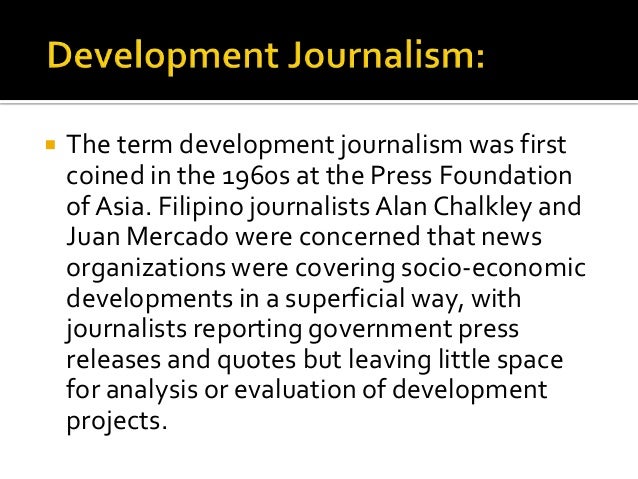
The origin of the term “development journalism” or sometimes known as development communications goes back to the 1960’s. Development Journalism is a concept at the center of new information order. It happens to be that, supporters and the critics of the formation of the new kind of journalism are not always clear of the meaning or method of application in a particular situation source. Since development journalism has been defined and used in different contexts, it has been linked with larger press freedom against government control issues. This essay will discuss whether development journalism is a government say-so journalism or is it a totally different concept. The paper will unfold in two parts. Firstly, it will argue that development journalism is called government say-so journalism where it will elaborate on one negative effect of media partnership with state, the function of media in in promoting national government agenda and how development journalism challenges the traditional watchdog role of the press. Then, the document will highlight how media partnership with state can be beneficial to both parties, how the concept of development communication can contribute to state development, as well as identify and justify which group best fits into the development journalism concept.
To begin with, one of the negative effect of the press partnering with state is that, the media organization can be very easily influenced by the government in their delivery of news content (Ismail, 2013)The media can also be accused of being the governments puppet which can be harmful to the media organization’s image and credibility According to Awan Ismail in the article “Exploring the strengths and limitations of Development Journalism in Malaysia” claims that development journalism is the “critical examination, evaluation and report of relevance which demands the press to be independent of government” (Ismail, 2013). Thus, it is important that the press remains an independent body to ensure reporting is fair and balanced.
Similarly, with development journalism model in existence, it has been argued that “the press ideally functions to serve the national agenda and those in power” (Ismail, 2013). It further states that governments through mass media promote whatever an authoritarian government wishes to develop or create (Ismail, 2013), good to compare and contrast multiple sources rather than rely mainly on one source.This can be challenging for media organizations for it may seem the government is undermining or exercising control over its independence. It may also be interesting to note that the state may also use social media as medium of promoting its intension more effectively and quickly.
Likewise, development journalism had be widely criticized by western countries as it raised concerns on the freedom of press (Tshabangu, 2013) as it challenges the rights of journalists and can affect the quality and credibility of information given to the public. Development journalism provides states the opportunity to exercise control over the media. This can be dangerous for the press if the state feels that the media is abusing its power and agitating the state, the government can regulate the media and impose fines on media organizations. For example, in countries such as Malaysia and Indonesia (Romano, 1999). Therefore, development journalism with the traditional watchdog role of the media, as strict laws and fines can create fear among journalists which can affect the quality of work.
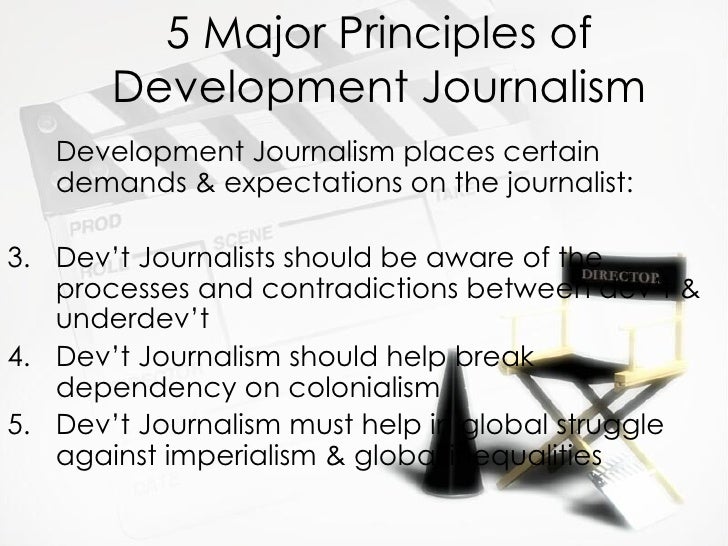
5 Major principles of Development Journalism
On the other hand, state partnership with the press can allow governments to advertise vacancies and other information at a lower cost. This concept of media buying (Media Buying, 2020) can be highly beneficial for both the government and the media involved, as it shows “how taxpayers money is being used and on what, cheap advertising price, and flexible framework agreement” (Media Buying, 2020). The government media partnership promotes accountability of taxpayers’ funds and gives the state an opportunity to market its regime with limited cost but it could lead to pro government media as in the case of Fiji Sun and FBCL.
Moreover, development journalism is said to be more solution oriented (McPhail, 2009) as it aims to contribute towards nation-building (Ismail, 2013). The idea of development journalism is to “alert the public of development problems and for the media to work with government and find solutions to matters arising (Ismail, 2013). For example, media reporting in Malaysia may focus on regional reporting rather than internal, as this will help strengthen political relationship within Asia and contribute to improving lives of Asian citizens (Ismail, 2013). Hence, development journalism is an important mechanism in shaping political relationships between countries as political statements in the press is a way of communicating ideas and thoughts in politics.
Lastly, development journalism concept is greatly recommended for developing and multicultural nations as they are characterized by conflict and opposition and deemed culturally appropriate (Singh, 2020). An example, where this concept can be applied is the Pacific islands region. An area surrounded by oceans and developing states with growing economy (Ismail, 2013) and political instability, development journalism could be the way forward. One way development journalism could be achieved through mindful practices, moral wisdom and ethics training (Pacific Media Centre, 2016).
To conclude, this essay has discussed how development journalism can be classified as government say-so journalism where the press could be influenced through media partnership with state was highlighted, the media ideally functions to serve the national agenda of government and those in power was argued alongside the view that development journalism is a threat to the traditional watchdog role of the media. However, the document also enlightens that there are some positive sides as well, which includes; low cost of advertising if the state and media are in partnership, development journalism is solution oriented journalism, which is highly recommended for developing nations such as Pacific island states as it offers development methods and resolutions.
Below are the list of sources used in the preparation of the essay. Also note that the sources does not include additional sources used in preparing this blog post.
Bibliography
Ismail, A. (2013). Exploring the Strenghts and Limitations of Development Journalism in Malaysia. Adelaide: The University of Adelaide .
McPhail, T. L. (2009). Introduction to Development Communication. Blackwell Publishing Ltd. doi:10.1002/9781444310740
Romano, A. (1999). Development Journalism: State versus Practitioner Perspectives in Indonesia. Media Asia, 26(4), 183-191. doi: 10.1080/01296612.1999.11726592
Singh, S. (2020). Development Communication & Development Journalism. Lecture Notes .
Tshabangu, T. (2013). Development Journalism in Zimbabwe: Practice, Problems, and Prospect. Journal of Development Communication Studies, 2, 312-326.
so, before I take leave I would like to share a short video clip on how to be a great journalist. I know for a fact that nowdays we have more citizen journalists than qualified and professional journalists.
so just be careful of the type of information you receive from whom and the source of information and be sure to rely on credible news sources.
Here’s how to be a great journalist
Hope you enjoyed the presentation. Till we meet the next time, thanks for reading. Bye!
Hello everyone! Hope you all are doing great. Today’s presentation is a lot different from any other usual topic.
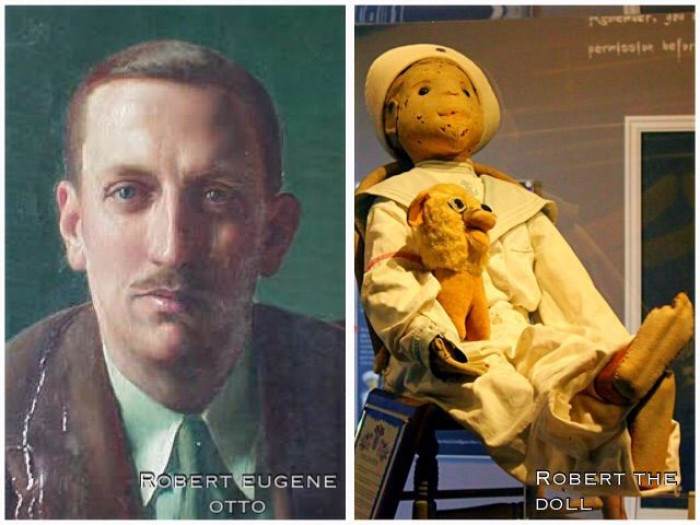
Robert: The Doll
This doll looks cute. Doesn’t it? But don’t go too much into his beauty.
Now, you must be thinking what I am saying here.
Well, to tell you the truth, this is not an ordinary doll or toy.
It is believed that this particular doll is haunted. And I’ll share some interesting facts about this doll in my presentation. So be sure to read this article till the end.
The story of Robert the doll dates back to the 1900’s when the doll was given to a boy by the name of Robert Eugene Otto also known as Gene.
Made from wood wool known as excelsior, Robert is dressed in a sailor’s suit with a lion in his hand.
It is said that the hand-made doll was given to Gene as a retaliation gift by one of the servants working at his parents’ home.
The gift came after Gene’s mother who was said to be a very cruel lady, one day caught some servants practicing black magic and quickly fired them.
While one of the servant’s is said to have possessed the doll with an evil spirit and given it to the little child, to which the Otto family had no objection unknowingly of the consequences that were likely to happen.
Upon receiving the doll, Gene decided to name the doll Robert since he was commonly called Gene.
The house of Robert Eugene Otto (referred to as the Artist House) , im Key West Florida, USA
Soon Gene became so obsessed with the doll that they became inseparable.
He would take Robert wherever he would go, reserve a seat at the dining table and pretend to feed Robert with some pieces of his food.
Now, to this point you must be thinking this behavior is okay and some would even argue that that’s normal with kids.
Yes I agree with the fact that children tend to have some form of attachment towards certain toys or their favorite toy.
Then, here’s the twist in the tale. Gene’s parents Mr & Ms Otto discovered a voice respond to Gene every time their son tried to have a conversation with the doll.
At first they thought Gene was making sounds himself. But they soon realized that the sound was like a heavy voice, which was difficult for a four year old boy like Gene to make.
The Otto family claimed to have experienced paranormal activities such as hearing sounds of giggling and evil laughter, as well as, seeing Robert move.
Even neighbors of the “Artist House” claim to have seen Robert look through the window with his facial expressions changing.
Those who have camped at the “Artist House” during the presence of Robert claim to have felt the presence of something strange.
To separate the two, Robert was locked in a cabinet in the etic where it stayed for quite a long time.
Claims of Robert’s presence in the basement was being felt despite the doll being locked in its cabinet.
About Robert Eugene Otto
Robert Eugene (called Gene) was the son of affluent and well-traveled parents, Mr and Mrs. Thomas Otto.
He was born on 25th October 1900 and died at the age of 73, the year 1974.
Robert was well known for his painting in the Key West area apart from his obsession for Robert.
After the death of his father Mr Thomas Osgood Otto, Gene became the Owner of their Key West home where he moved to with his wife Ann.
Things changed after he discovered his long lost friend Robert in the basement’s cupboard and the two reunited.
The reunion did not go down well with Gene’s wife as he would take it anywhere the couple would go.
As a result, the couple would end-up in argument with Gene sometimes going insane and would not recall anything about his behavior and blame Robert for any mishaps.
What made the equation worse was that, before sleeping Gene would place Robert on a chair inside the couple’s bedroom.
New Home of Robert the Doll
After the death of Gene and his wife, the house was sold with Robert being locked back in the etic.
The family that bought the house had a little girl who found Robert in the etic and decided to keep it.
Seemed like Robert did not like his new owner and all mishaps began to happen including scary dreams.
This forced the new owner to deliver Robert to the Fort East Martello Museum, in Key West Florida.
Robert the doll sitting in a glass at Fort East Martello Museum
The reason to keep it in a glass is to prevent people from touching it as Robert does not like to be touched or his photo taken without his permission.
Those that have breached this rule have suffered or suffer from Robert’s curse through which they get involved in a road accident or something bad happens with the offender or offenders.
The pieces of paper seen in the glass are said to be apology letters from the victims of Robert’s curse in the hope of forgiveness from the doll.
Not only that. This haunted doll rules the Fort East Martello Museum after dark.
Here’s how Robert rules his new home
Finally, I’ll leave you with a video that contains the story Chucky the doll, the concept of the movie is taken from Robert the doll.
Hello everyone! The following is a feature article which I had written as an assignment for one of my core units. I hve made some structural changes, as well as modified it a bit by adding my own views at a couple of places.
For many University of the South Pacific students, life was going smoothly until the arrival of the coronavirus (COVID 19) Pandemic.
While the Pacific region was largely spared the chaos and death the virus caused in the developed world, the economic impact was just as resounding.
It was made worse by Tropical Cyclone Harold, a Category 5 storm which struck the Solomon Islands on the 2nd of April 2020, causing severe flooding’ damaging houses and infrustructure as well as cusing four deaths.
Damage caused by TC Harold
Tropical cyclone then affected other Pacific Island states including; Vanuatu, Fiji and Tonga.
According to experts, the double impact of \natural disaster and global pandemic are likely to have a wide-ranging impact on students at USP.
University of the South Pacific, Laucala Campus, Suva, Fiji
Economic & Mental Health Impacts
Discipline leader psychology at USP’s psychology department, Annie Crookes, said the full extent of the damage caused by the pandemic was still unclear.
The continuing uncertainty could have an impact on the mental well-being of USP students.
“Not only is there change, disruption and new things to cope with in a short span of time but future employment opportunities, health and wealth of countries are no longer predictable”, Ms Crookes said.
She adds, “Decisions will need to be made about their continuation of studies alongside other priorities.
The University has implemented an online learning system for the remainder of the academic year.
Online learning can be fun as you do not have to be physically present in class and give attendance.
However, there are some teething issues students are facing which is usually the case with any new system.
Fouzmin Nisha, a Bachelor of Arts & Education student at USP, says online learning has been difficult especially as a person with vision impairment.
“I heavily rely on screen reading software to help me access online content and because information on websites are not too accessible with our technology, we have to depend on other people for help”, Fouzmin Nisha said.
“The University’s Disability Resource Centre has allocated buddies who meet me couple of times a week to help in retrieving information online, they also help me with online quiz and pretty much anything internet related”, she said.
Furthermore, students’ ability to pressure online learning depends on how well they can focus outside the school environment or when they are left unsupervised.
As a university student, we are expected to be self-learners or sometimes referred to as independent learners which I believe is not an easy task for everyone.
So, here’s what Ms Crookes suggests, “Building a routine, creating a study plan and sticking to it or trying to stick to it for a week or two, “to see if it becomes a habit.”
I personally think this idea is good because it allows you to have more free time, which means you have time for other stuffs like reading a story book, playing video games or spending time with friends and families. In short, it enhances time management skills.
student studying online
First Year Students
The challenge may be steeper for first year students still getting used to the university system.
I think students who have recently joined from high school are going to be particularly affected due to the fact that just as they seemed to have been settling into their chosen mode of study, a pandemic forced everything online.
The excitement of studying on campus and making new friends just got ruined.
While there’s not much we can do, I reemphasize Ms Crookes’s idea of time management which can be beneficial not only in studies but in the near future.





























 IN THE WHITE