
Hi there everyone! Hope you all are well. The following article is a media topic essay which I had written for one of my core unit. The discussion surrounds the concept of “Development Journalism”. Its central focus is on the pros & cons of “Development Journalism.”Before I proceed any further, I must highlight that the “Development Journalism” has been quite commonly used in the Asia-Pacific region. Since I do not wish to make any changes to the presented document it will take a neutral stance and it is up-to the reader to decide whether “Development Journalism”is government say-so journalism.
However, personally I do not support development journalism as I feel it compromises with the traditional watchdog role of the media. While this debatable topic is for a thorough discussion at a later date. Here I present both sides of the story for you to answer “whether “Development Journalism” is government say-so journalism.”
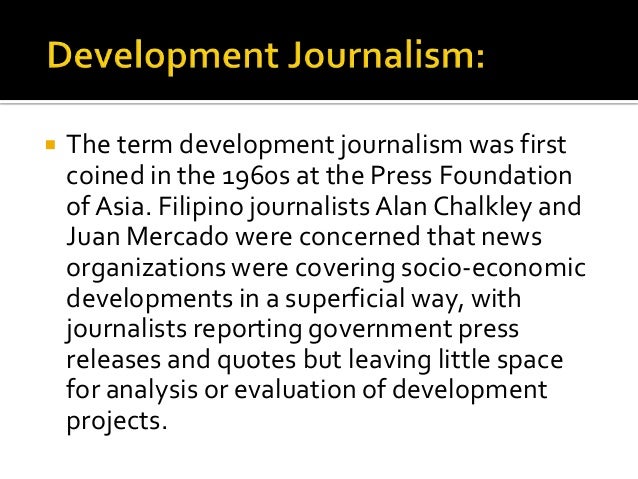
The origin of the term “development journalism” or sometimes known as development communications goes back to the 1960’s. Development Journalism is a concept at the center of new information order. It happens to be that, supporters and the critics of the formation of the new kind of journalism are not always clear of the meaning or method of application in a particular situation source. Since development journalism has been defined and used in different contexts, it has been linked with larger press freedom against government control issues. This essay will discuss whether development journalism is a government say-so journalism or is it a totally different concept. The paper will unfold in two parts. Firstly, it will argue that development journalism is called government say-so journalism where it will elaborate on one negative effect of media partnership with state, the function of media in in promoting national government agenda and how development journalism challenges the traditional watchdog role of the press. Then, the document will highlight how media partnership with state can be beneficial to both parties, how the concept of development communication can contribute to state development, as well as identify and justify which group best fits into the development journalism concept.
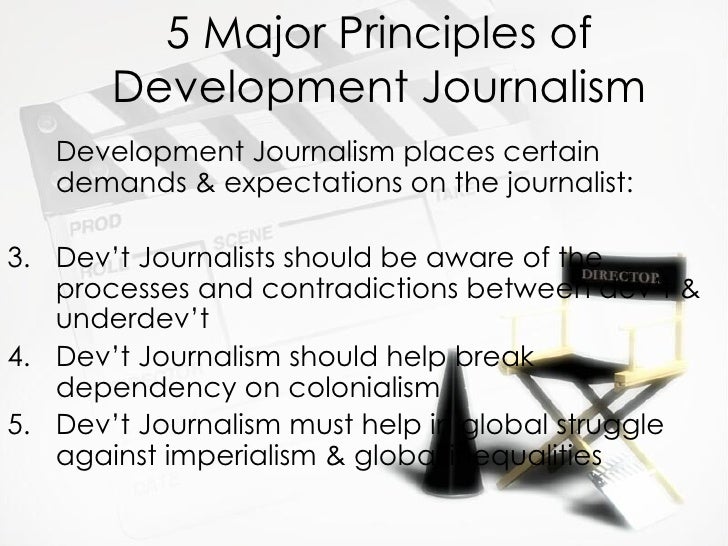
To begin with, one of the negative effect of the press partnering with state is that, the media organization can be very easily influenced by the government in their delivery of news content (Ismail, 2013)The media can also be accused of being the governments puppet which can be harmful to the media organization’s image and credibility According to Awan Ismail in the article “Exploring the strengths and limitations of Development Journalism in Malaysia” claims that development journalism is the “critical examination, evaluation and report of relevance which demands the press to be independent of government” (Ismail, 2013). Thus, it is important that the press remains an independent body to ensure reporting is fair and balanced.
Similarly, with development journalism model in existence, it has been argued that “the press ideally functions to serve the national agenda and those in power” (Ismail, 2013). It further states that governments through mass media promote whatever an authoritarian government wishes to develop or create (Ismail, 2013), good to compare and contrast multiple sources rather than rely mainly on one source.This can be challenging for media organizations for it may seem the government is undermining or exercising control over its independence. It may also be interesting to note that the state may also use social media as medium of promoting its intension more effectively and quickly.
Likewise, development journalism had be widely criticized by western countries as it raised concerns on the freedom of press (Tshabangu, 2013) as it challenges the rights of journalists and can affect the quality and credibility of information given to the public. Development journalism provides states the opportunity to exercise control over the media. This can be dangerous for the press if the state feels that the media is abusing its power and agitating the state, the government can regulate the media and impose fines on media organizations. For example, in countries such as Malaysia and Indonesia (Romano, 1999). Therefore, development journalism with the traditional watchdog role of the media, as strict laws and fines can create fear among journalists which can affect the quality of work.
On the other hand, state partnership with the press can allow governments to advertise vacancies and other information at a lower cost. This concept of media buying (Media Buying, 2020) can be highly beneficial for both the government and the media involved, as it shows “how taxpayers money is being used and on what, cheap advertising price, and flexible framework agreement” (Media Buying, 2020). The government media partnership promotes accountability of taxpayers’ funds and gives the state an opportunity to market its regime with limited cost but it could lead to pro government media as in the case of Fiji Sun and FBCL.
Moreover, development journalism is said to be more solution oriented (McPhail, 2009) as it aims to contribute towards nation-building (Ismail, 2013). The idea of development journalism is to “alert the public of development problems and for the media to work with government and find solutions to matters arising (Ismail, 2013). For example, media reporting in Malaysia may focus on regional reporting rather than internal, as this will help strengthen political relationship within Asia and contribute to improving lives of Asian citizens (Ismail, 2013). Hence, development journalism is an important mechanism in shaping political relationships between countries as political statements in the press is a way of communicating ideas and thoughts in politics.
Lastly, development journalism concept is greatly recommended for developing and multicultural nations as they are characterized by conflict and opposition and deemed culturally appropriate (Singh, 2020). An example, where this concept can be applied is the Pacific islands region. An area surrounded by oceans and developing states with growing economy (Ismail, 2013) and political instability, development journalism could be the way forward. One way development journalism could be achieved through mindful practices, moral wisdom and ethics training (Pacific Media Centre, 2016).
To conclude, this essay has discussed how development journalism can be classified as government say-so journalism where the press could be influenced through media partnership with state was highlighted, the media ideally functions to serve the national agenda of government and those in power was argued alongside the view that development journalism is a threat to the traditional watchdog role of the media. However, the document also enlightens that there are some positive sides as well, which includes; low cost of advertising if the state and media are in partnership, development journalism is solution oriented journalism, which is highly recommended for developing nations such as Pacific island states as it offers development methods and resolutions.
Below are the list of sources used in the preparation of the essay. Also note that the sources does not include additional sources used in preparing this blog post.
Bibliography
Ismail, A. (2013). Exploring the Strenghts and Limitations of Development Journalism in Malaysia. Adelaide: The University of Adelaide .
McPhail, T. L. (2009). Introduction to Development Communication. Blackwell Publishing Ltd. doi:10.1002/9781444310740
Media Buying. (2020). Government Communication Services. Retrieved May 28, 2020, from https://gcs.civilservice.gov.uk/guidance/media-buying/
Romano, A. (1999). Development Journalism: State versus Practitioner Perspectives in Indonesia. Media Asia, 26(4), 183-191. doi: 10.1080/01296612.1999.11726592
Singh, S. (2020). Development Communication & Development Journalism. Lecture Notes .
Tshabangu, T. (2013). Development Journalism in Zimbabwe: Practice, Problems, and Prospect. Journal of Development Communication Studies, 2, 312-326.
so, before I take leave I would like to share a short video clip on how to be a great journalist. I know for a fact that nowdays we have more citizen journalists than qualified and professional journalists.
so just be careful of the type of information you receive from whom and the source of information and be sure to rely on credible news sources.
Hope you enjoyed the presentation. Till we meet the next time, thanks for reading. Bye!
 IN THE WHITE